
A practical, evidence-aware guide to EAAs, protein, resistance training, muscle maintenance after 50, and how to evaluate amino-acid supplements without falling for exaggerated claims.
There is a point many people notice sometime in their 50s or 60s.
The groceries have not become heavier. The stairs have not become steeper. Your workout has not suddenly doubled in difficulty.
Yet somehow, carrying, climbing, recovering and staying strong can require a little more effort than they used to.
That change is not simply imagination.
 |
| Essential Amino Acids After 50: What Actually Helps Maintain Muscle, Strength and Recovery? |
Muscle mass, strength and the way muscle responds to nutrition change with age. Researchers sometimes describe part of this process as anabolic resistance: older muscle may respond less strongly to the same protein and amino-acid stimulus that worked well earlier in life. See research.
That has created growing interest in essential amino acids, or EAAs, especially among adults who want to stay active, preserve strength and continue doing the things they enjoy as they get older.
But there is an important distinction to make.
Amino acids are not a shortcut around exercise, good nutrition or adequate protein. And not every product labeled “amino acids” provides the same ingredients—or the same amount of useful information.
Why Maintaining Muscle Becomes More Important After 50
People often think of muscle primarily in terms of appearance.
In reality, muscle affects much more than the way someone looks.
Strength helps you get out of a chair without assistance. It helps you carry groceries, climb stairs, travel, garden, play with grandchildren and remain physically independent.
Age-related loss of muscle mass and function can eventually contribute to a condition known as sarcopenia. Clinical guidance places progressive resistance training at the center of prevention and management, while adequate protein and energy intake remain important nutritional foundations. Read the clinical review.
What Are Essential Amino Acids?
Proteins are built from amino acids.
The human body can manufacture some amino acids on its own. Others must come from food because the body cannot synthesize enough of them.
Modern nutritional science recognizes nine essential amino acids:
- Histidine
- Isoleucine
- Leucine
- Lysine
- Methionine
- Phenylalanine
- Threonine
- Tryptophan
- Valine
Reference: National Academies / NCBI
Among them, leucine receives considerable attention because it participates in signaling pathways involved in muscle protein synthesis. Research also suggests that aging muscle may require a stronger leucine/amino-acid stimulus to generate the same anabolic response.
But leucine does not work in isolation.
Think of building muscle protein like assembling something from multiple parts. Turning on the assembly line is useful, but you still need the complete supply of necessary materials.
That is one reason complete essential-amino-acid formulas attract more interest than BCAA-only products.
EAA vs. BCAA vs. Whey Protein: What Is the Difference?
| Option | What it provides | Main advantage | Main limitation |
|---|---|---|---|
| BCAA | Leucine, isoleucine, valine | Simple and widely available | Only three essential amino acids |
| EAA supplement | Ideally all essential amino acids | Concentrated amino acids with relatively little food volume | Formula quality and doses vary substantially |
| Whey protein | Complete protein containing all essential amino acids | Strong research base and substantial protein per serving | Larger serving, extra calories, dairy-based |
| Whole-food protein | Protein plus other nutrients | Should remain the dietary foundation | May be harder to consume in sufficient amounts for some older adults |
One mistake is assuming that EAAs automatically make whey obsolete. They do not.
Whey remains a high-quality protein source, and clinical research has found benefits in some older populations, particularly alongside resistance training. A 2024 systematic review found that whey combined with resistance exercise could improve some lower-body strength outcomes, although results across other outcomes were mixed. See the review.
In one study involving older adults, whey produced greater muscle protein accrual than an isolated amount of EAAs matched to its amino-acid content. See the study.
So the useful question is not: “Are amino acids better than protein?”
It is: “Which form best fits my diet, appetite, activity level and nutritional needs?”
What Does the Research Say About Essential Amino Acids in Older Adults?
A randomized clinical trial involving older adults studied 15 grams of EAAs daily, aerobic exercise, or combinations of the two over 24 weeks. Exercise improved aerobic fitness and walking speed, while increased muscle strength was observed specifically in the group receiving EAAs combined with exercise. View the trial.
Another randomized trial in institutionalized older adults reported improvements in measures including grip strength after eight weeks of essential-amino-acid supplementation compared with placebo. View the study.
But research is not uniformly positive.
A 2026 randomized trial using leucine-enriched EAAs with different exercise programs did not find a significant increase in appendicular muscle mass after six months. The authors concluded that additional clinical studies are still needed. View the study.
What Should You Look for in an Amino-Acid Supplement After 50?
The front label is not the most important part. The Supplement Facts panel is.
I would ask five questions:
- Which amino acids are actually included?
- How much total amino-acid material is supplied per serving?
- Are individual amino-acid amounts disclosed?
- How many tablets, capsules or scoops are needed?
- Does the format realistically fit your daily routine?
That brings us to one formula that has become increasingly visible among older adults looking for a tablet-based alternative to protein shakes.
A Closer Look at Advanced Amino Formula
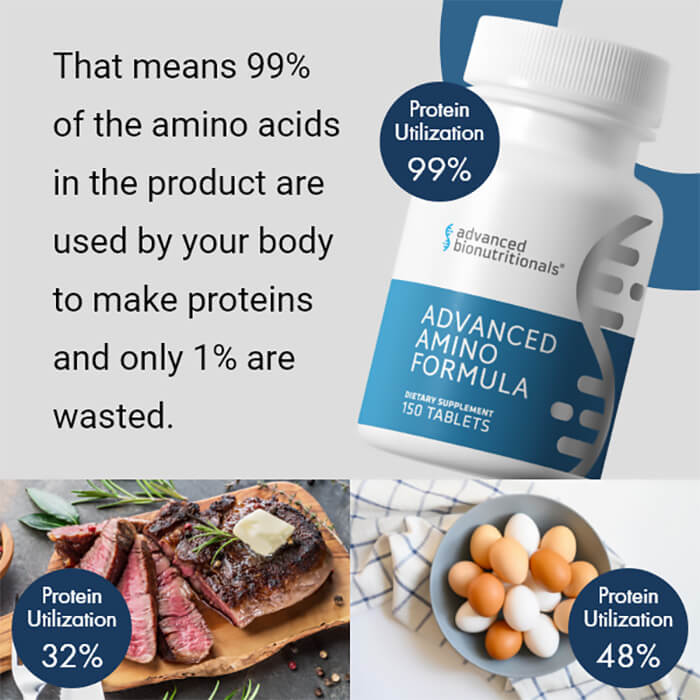
Advanced Amino Formula, sold by Advanced Bionutritionals, is a tablet-based amino-acid supplement built around an approximately 5,000 mg amino-acid blend per five-tablet serving.
The current label lists:
- L-Leucine
- L-Valine
- L-Isoleucine
- L-Lysine HCl
- L-Phenylalanine
- L-Threonine
- L-Methionine
- L-Tryptophan
A bottle contains 150 tablets, equivalent to 30 five-tablet servings.
This gives the formula one immediately attractive feature: convenience.
There is no powder to mix, no flavor to tolerate and no protein shake to prepare.
One Detail Worth Understanding Before Buying
Advanced Amino Formula contains eight of the nine amino acids currently recognized as essential for adults. It does not contain histidine.
The manufacturer provides its own explanation for this decision, but contemporary nutritional references classify histidine as an essential dietary amino acid because humans cannot synthesize enough of it. See reference.
That does not automatically mean the formula is ineffective.
It does mean that I would not describe it as a complete nine-EAA formulation.
There is another transparency limitation: although the label provides the total 5,000 mg blend amount, it does not disclose the exact milligram amount of each individual amino acid. That makes direct comparison with study dosages more difficult.
So Why Is Advanced Amino Formula Still Interesting?
Because the underlying nutritional category is legitimate.
The formula contains leucine and seven other nutritionally important amino acids in a convenient free-form supplement, while the broader science supporting essential amino acids in muscle protein metabolism is substantial.
It also solves a practical problem.
Not everyone wants another large shake every day.
Some adults find their appetite changes with age. Others already consume protein through food and simply want a compact supplement they can take alongside an active lifestyle.
That is where a tablet formula can make sense—as an additional nutritional tool, not as a replacement for lifting weights, walking, sufficient protein or medical advice.
Want to inspect the formula yourself?
Review the current label, pricing and 90-day guarantee on the official product page before deciding.
Advanced Amino Formula Price and Guarantee
At the time this guide was prepared, the manufacturer's product page showed approximately:
| Package | Listed price | Approx. bottle price |
|---|---|---|
| 1 bottle | $39.95 | $39.95 |
| 3 bottles | $107.85 | $35.95 |
| 6 bottles | $199.50 | $33.25 |
The three- and six-bottle packages have been shown with free shipping, and the product is advertised with a 90-day money-back guarantee. Because pricing and shipping promotions can change, verify the live offer before purchasing.
Check the current Advanced Amino Formula offer →
What Do Buyers Say?
The manufacturer's review section has displayed more than 3,000 customer reviews, an average rating around 4.1/5 and a large majority of reviewers indicating that they would recommend the supplement.
Those experiences should be interpreted carefully.
Testimonials tell us what individual customers believe happened to them. They do not establish what the average buyer will experience. Clinical evidence about EAAs should carry more weight than dramatic before-and-after stories.
Who Is Most Likely to Appreciate This Type of Supplement?
Advanced Amino Formula makes the most sense to me for an adult who wants a simple tablet-based amino-acid supplement, dislikes powders, values convenience, and already understands that maintaining muscle requires resistance exercise and adequate nutrition.
It is less compelling for someone who:
- wants exact milligram amounts for every amino acid,
- insists on a formula containing all nine recognized EAAs, or
- already comfortably meets protein needs through food and sees no practical need for an additional supplement.
What About Muscle Loss After 50?
If you are worried about losing strength as you get older, supplements should not be the first or only intervention.
Resistance exercise has the strongest practical role.
International clinical guidance recommends resistance-based exercise for older adults with sarcopenia and also emphasizes adequate protein and calorie intake. See guidance.
Is Advanced Amino Formula Better Than BCAAs?
From a nutritional-completeness perspective, the Advanced Amino Formula blend is broader than a typical BCAA supplement.
BCAAs provide only leucine, isoleucine and valine.
Advanced Amino Formula provides those three plus lysine, phenylalanine, threonine, methionine and tryptophan.
However, it still omits histidine, so it is more accurate to describe it as an eight-amino-acid EAA blend rather than a complete nine-EAA formula.
Is It Better Than Whey Protein?
Not automatically.
Whey and free-form amino acids solve somewhat different practical problems.
Whey supplies substantial complete protein and all nine essential amino acids. Amino-acid tablets provide a smaller, concentrated dose without requiring a shake.
The idea that whey simply “doesn't work” is not supported by the broader research literature. Clinical studies show that whey can contribute to muscle-related outcomes in older adults, especially when paired with exercise.
If you need more total protein, whey or food may make more sense. If you already eat enough protein but value a compact amino-acid format, an EAA-style supplement may be more convenient.
Are There Safety Considerations?
Advanced Amino Formula contains phenylalanine.
Individuals with phenylketonuria (PKU) should use amino-acid products only under appropriate medical supervision.
More broadly, people with kidney disease, liver disease, metabolic disorders, significant medical conditions or prescription medications should discuss concentrated amino-acid supplementation with an appropriate healthcare professional.
Frequently Asked Questions
What are the best amino acids for muscle after 50?
There is no single “best” amino acid for everyone. Leucine receives significant attention because of its role in muscle-protein signaling, but muscle proteins require multiple amino acids. Complete dietary protein or a well-designed essential-amino-acid mixture generally has a stronger nutritional rationale than leucine alone.
Do essential amino acids build muscle without exercise?
They provide nutritional building blocks and can influence muscle-protein metabolism, but supplementation should not be treated as a substitute for resistance exercise.
Are EAAs better than BCAAs for older adults?
EAAs provide a broader range of essential amino acids than BCAAs, which contain only leucine, isoleucine and valine. That gives EAA formulations a stronger nutritional rationale when the goal is supplying multiple required building blocks.
How many tablets are in Advanced Amino Formula?
The current label lists 150 tablets per bottle and a serving size of five tablets, giving approximately 30 servings per bottle.
Does Advanced Amino Formula contain all nine essential amino acids?
No. It contains eight: leucine, valine, isoleucine, lysine, phenylalanine, threonine, methionine and tryptophan. It does not contain histidine.
Is Advanced Amino Formula vegan?
The manufacturer currently describes the product as vegan and free of animal products. Always verify the latest product label if dietary restrictions are important to you.
Is Advanced Amino Formula worth trying?
If you expect a pill to replace exercise and rebuild lost muscle by itself, the evidence does not justify that expectation. If you are already active and specifically want a convenient tablet-based source of multiple amino acids, the formula is more reasonable to consider.
Final Verdict
The most convincing argument for essential amino acids after 50 is not a dramatic marketing promise. It is basic physiology.
Muscle requires regular use, adequate energy, protein and amino acids. Aging can make that equation less forgiving, which is why strength training and nutrition become more—not less—important over time.
Advanced Amino Formula offers a convenient way to add an eight-amino-acid blend without another protein shake. There is legitimate scientific research behind essential-amino-acid supplementation as a category, but the evidence does not prove that this particular product will rebuild muscle for every user.
That distinction is exactly why I consider it a product worth evaluating, rather than blindly recommending.
For an active adult over 50 who values convenience and wants additional amino-acid support alongside exercise and a sensible diet, it may be a reasonable option.
For someone who wants a transparent nine-EAA formula with every individual dose disclosed, there are reasons to continue comparing.
Review the label before you decide
Check today's price, formula details and guarantee directly on the official product page.

.jfif "Gallbladder Surgery Muscle Loss After 50: Does Gallbladder Removal Soften Strength (And What Actually Helps)?")


