
After 50, many people still “eat protein” and still feel weaker on the stairs.
Eggs at breakfast. Chicken at lunch. A yogurt in the afternoon. On paper, that looks responsible. In the body, muscle protein synthesis in older adults often needs a clearer trigger than a casually average plate provides. Researchers and coaches often describe that trigger as a leucine threshold—roughly in the ballpark of ~2.5–3 g of leucine per meal for many midlife and older adults, alongside enough of the other essential amino acids (EAAs) to actually build with.

That is the heart of leucine threshold muscle protein synthesis after 50: not “protein is useless,” but “protein quality, dose, and distribution matter more than they used to.”
Educational note: This article is educational, not medical advice. It does not diagnose or treat sarcopenia or any disease. Individual needs vary; talk with a qualified clinician before concentrated amino-acid supplements if you have PKU, kidney or liver disease, or complex medications.
What “leucine threshold” means after 50
Leucine is one essential amino acid that helps switch on muscle protein synthesis (often discussed through pathways like mTOR). In younger muscle, a modest protein meal may clear the bar more easily. With age, anabolic resistance can raise the bar: the same “normal” serving may under-trigger the response.
So when people search how much leucine per meal over 50, they are really asking: Did this meal give muscle a loud enough signal?
Practical implications:
- Spreading tiny protein snacks all day may keep you full without ever clearing the threshold
- A single huge dinner may help once, then leave long gaps
- Protein quality leucine older adults matters—animal proteins and some fortified options are typically denser in leucine per gram than many plant staples (plant patterns can still work with larger portions or smarter combining)
The threshold idea is a guide, not a lab sentence you must hit with a calculator at every bite. It is a reason to stop assuming “I ate some protein” equals “I stimulated muscle.”
Anabolic resistance leucine trigger (plain English)
Anabolic resistance means older muscle often responds less strongly to the same amino-acid stimulus. The leucine trigger is one part of closing that gap: enough leucine to signal, plus enough total essentials to supply building blocks, plus progressive loading so the signal has somewhere to go.
For early functional signs of decline, see muscle loss after 50. For the broader EAA foundation, see essential amino acids after 50.
~2.5–3 g leucine — and why a full EAA set still matters
Leucine is the spark. It is not the whole fire.
- BCAA products typically provide leucine, isoleucine, and valine only
- EAA products aim to provide a broader essential set so signaling and building materials travel together
- Food / whey can deliver leucine and a complete protein package when portions are large enough
That is why essential amino acids vs BCAA after 50 is not a brand war—it is a completeness question. If you want the dedicated comparison, read EAA vs BCAA after 50.
For leucine for sarcopenia / muscle loss after 50, the honest framing is support inside a training-and-food plan—not a cure label.
EAA vs BCAA vs whey (decision snapshot)
| Option | Leucine signal | Building blocks | Best when… |
|---|---|---|---|
| Food / whey | Can be high if the serving is solid | Complete protein | You need total protein + calories |
| BCAA | Often strong on leucine | Incomplete (3 AA) | You want a narrow, simple product |
| EAA tablets | Formula-dependent | Broader essentials | You want a compact EAA supplement for muscle after 50 |
Tablets do not automatically beat whey. They solve a different job: concentrated essentials without forcing another large serving—after you already respect training and meals.
Training first (non-negotiable)
Resistance training amino acids sarcopenia research keeps repeating the same hierarchy: load the muscle, feed the muscle, recover, then consider supplements.
Without progressive resistance work 2–3 times per week (joint-friendly and consistent), chasing leucine numbers becomes expensive trivia. For practical strength habits, see build muscle after 50.
When Advanced Amino Formula may fit
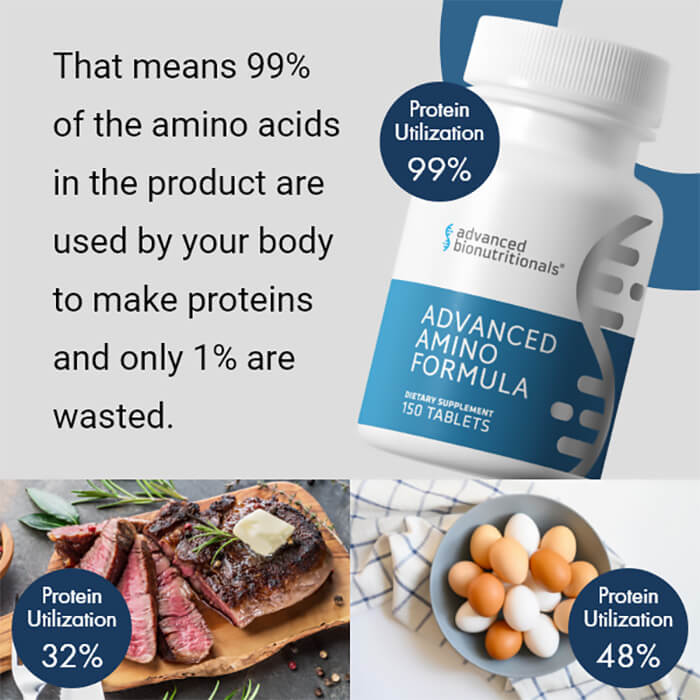
Advanced Amino Formula is a tablet product with a free-form blend of eight essential amino acids, including leucine, valine, isoleucine, lysine, phenylalanine, threonine, methionine, and tryptophan. Materials commonly describe about a 5,000 mg blend per serving (often five tablets). Always follow the live label.
Fit: you already train (or are restarting), you care about meal leucine/EAA quality, and you want a compact option as support—not as your whole strategy.
Limits (read these):
- Eight EAAs listed; histidine is not included (many references list nine)
- Total blend is clearer than exact milligrams of each amino acid—so you cannot treat the bottle as a precision leucine calculator unless the label discloses it
- Manufacturer muscle claims are company claims, not your personal result
- PKU / significant kidney or liver disease → clinician guidance
One user, Jacqui, described energy and muscles that felt like they were “waking up and working.” Keep that secondary. This article is about thresholds and habits, not testimonials.
If that tradeoff fits, review the current offer here: Advanced Amino Formula.
Practical checklist
- Strength sessions on the calendar (2–3× / week)?
- At least one protein-forward meal that could plausibly approach a meaningful leucine dose?
- Protein distributed earlier in the day—not only at night?
- Sleep decent enough for recovery?
- Only then: consider an EAA supplement for muscle after 50 for compact support
- Label literacy: 8 vs 9 EAAs, blend transparency, live guarantee terms
Optional cluster read if you want tablet-format context without making format the whole thesis: amino acid tablets for muscle loss.
FAQ
How much leucine per meal over 50?
Many discussions cluster around ~2.5–3 g as a useful target range for stimulating muscle protein synthesis in older adults. Treat it as a practical guide, not a medical prescription—and remember total diet and training still dominate.
Are EAAs better than BCAAs after 50?
For building-block completeness, a broader EAA set usually has a clearer rationale than BCAA-only products. See our EAA vs BCAA breakdown.
Can amino acid tablets replace training?
No. Tablets cannot recreate the mechanical signal of resistance exercise.
Do I still need food protein?
Yes. Food first. Supplements are support.
Will hitting the leucine threshold reverse sarcopenia?
No honest article can promise that. Threshold thinking helps meal design; it does not erase aging or inactivity.
Bottom line
Leucine threshold muscle protein synthesis after 50 is a practical lens: older muscle often needs a clearer amino-acid signal than a casually “normal” plate provides—and leucine is a big part of that signal, inside a fuller EAA picture.
Keep the order: resistance training → food protein → sleep → optional tablets. If you want a compact eight-amino option after those basics, you can inspect Advanced Amino Formula with the limits above in mind.


