
You can train. You can eat decent protein. And still feel flatter on the stairs after a stretch of short, broken nights.

That is the everyday face of poor sleep muscle loss after 50. It is not drama. It is recovery debt. When sleep shrinks — or fragments — the body gets fewer quiet hours to adapt to the work you already did. Motivation dips. Meals get messier. The same workout leaves you sorer for longer.
So: does lack of sleep cause muscle loss after 50? It can contribute. It is rarely the only cause. Aging, inactivity, inadequate food protein, illness, and training quality all share the stage. And the fix is not a “sleep pill” masquerading as amino acids.
This Miracoulia Health guide explains what short or fragmented sleep is (and is not) linked to for midlife muscle, why one rough night is not a verdict, how to protect strength when nights are messy, and where free-form essential amino acid tablets can fit as compact support when exhausted weeks make meals slip — without pretending a bottle treats insomnia or apnea.
Educational note: This article is educational, not medical advice. It does not diagnose sarcopenia, insomnia, sleep apnea, or any disease. Associations in research are not the same as “bad sleep alone causes disease X.” Chronic insomnia, loud snoring, gasping at night, witnessed breathing pauses, or daytime collapse deserve a clinician’s attention — possible sleep apnea and other conditions need proper care, not blog protocols. Talk with a qualified clinician before concentrated amino-acid supplements if you have PKU, kidney or liver disease, a protein-restricted diet, or complex medications. Individual results vary.
Sleeping less is not a neutral “busy week” for midlife muscle
Lack of sleep muscle loss midlife often shows up before anyone says sarcopenia: heavier legs, worse recovery, messier meals, strength that “won’t stick.” Sleep quality muscle after 50 matters as much as clock hours. See early signs of muscle loss after 50 and how to maintain muscle after 50. Distinct from before-bed EAA timing, IF windows, or desk-sitting — here the problem is short or fragmented sleep.
What research-minded practice says (careful framing)
Acute sleep-deprivation MPS studies are mostly in younger adults (mechanism clues, not identical midlife proof). Observational work often links short sleep — and sometimes very long sleep — with higher sarcopenia-related risk. Association, not a single-cause verdict. One bad night is not a catastrophe; a rough week that also deletes training and protein is the bigger threat.
Aim for consistent sleep first
Many adults do best near 7–9 hours when life allows. Basics: fixed wake time, caffeine cutoff, darker cooler room, less late alcohol/screens. Red flags (loud snoring, witnessed apneas, severe daytime sleepiness, rapid weakness/falls) → clinician, not a blog protocol. EAAs are not an insomnia or apnea treatment.
Progressive resistance 2–3× / week when nights are messy
Keep 2–3 joint-friendly sessions; shorten or reduce intensity rather than vanish. Build context: what actually builds muscle after 50.
Protein on short-sleep weeks
Protect protein on purpose when exhaustion deletes meals — eggs, fish, poultry, dairy if tolerated, tofu, leftovers. Coaching ranges often ~1.0–1.2+ g/kg with training (guides, not prescriptions; clinician limits first). Spread across two to three occasions.
Where EAA tablets fit
Compact top-up when sleep debt makes meals sparse — not sedation, not a cure for insomnia, not a before-bed ritual as the main answer. Foundation: essential amino acids after 50.
Advanced Amino 8 EAAs — honest label
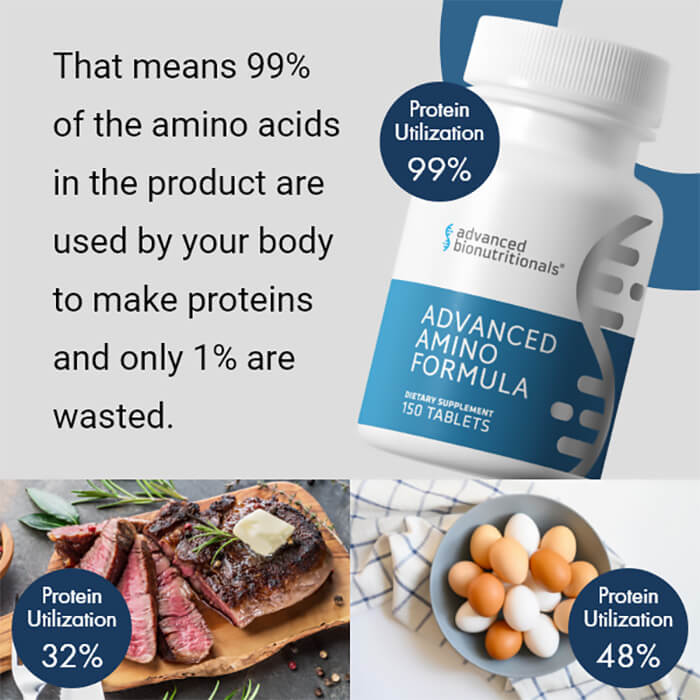
Advanced Amino 8 EAAs — proprietary free-form blend of eight EAAs (histidine not included); about 5 g across five tablets per serving. Follow the live label.
Buy-if: imperfect nights, you still lift, food protein mostly protected, want compact EAA when meals shrink.
Skip-if: tablets as sleep/apnea/lifting substitute; PKU/kidney-liver without clearance; need nine EAAs disclosed individually.
Review: Advanced Amino 8 EAAs.
Hierarchy (sleep edition)
- Better sleep where possible (+ clinical care for red flags)
- Resistance training 2–3×/week (scaled)
- Food protein across the day
- Optional EAA tablets on sleep-deprived weeks when meals slip
FAQ
Does lack of sleep cause muscle loss after 50? It can contribute; rarely the only cause.
How much sleep? Many adults near 7–9 hours; consistency and quality matter.
Can EAA tablets help on sleep-deprived weeks? When meals slip — if training and food basics remain. They will not fix insomnia or apnea.
Bottom line
Poor sleep muscle loss after 50 is real enough to take seriously — and practical enough to fight with a boring stack: better sleep habits (and clinical care when needed), resistance training 2–3× weekly, protein you will actually eat, then optional EAA tablets on the worst weeks.
Inspect Advanced Amino 8 EAAs after the sleep-and-training plan is honest.
Protect the night. Then protect the muscle.


