
Ask most adults how much protein should adults over 50 eat, and you will hear a daily number.

Thirty grams. Eighty grams. “A lot.” Daily totals matter. After 50, protein per meal after 50 often matters just as much — because muscle responds to meals, not only to end-of-day math on a tracker.
That is why a light coffee breakfast and a heroic dinner so often disappoint. The day looks fine in the app. The muscle stimulus was front-loaded into one sitting and missing for hours. Searching for how much protein at breakfast after 50 is often how midlife readers land here: they already “eat enough protein,” yet stairs feel stickier and training stalls.
This Miracoulia Health guide explains why protein distribution older adults coaching keeps returning to per-meal doses, why the light-breakfast / heavy-dinner pattern underperforms, practical ~25–40 g targets (guides, not prescriptions), and when free-form essential amino acid tablets can top up a meal that stays small — without replacing food or training.
Educational note: This article is educational, not medical advice. It does not diagnose sarcopenia, malnutrition, or any disease. Protein needs vary with body size, kidney health, activity, and clinical context. Talk with a qualified clinician before concentrated amino-acid supplements if you have phenylketonuria (PKU), kidney or liver disease, a protein-restricted diet, or complex medications. Individual results vary.
Why daily total alone isn’t enough
Protein distribution older adults research and coaching practice keep pointing to the same pattern: older muscle often needs a clearer per-meal amino-acid dose, repeated across the day — not one giant plate after a protein-poor morning.
If almost all protein lands at dinner:
- Morning and midday meals under-stimulate muscle protein synthesis
- Long gaps blunt useful muscle protein synthesis meal spacing
- You “hit your macros” while still underfeeding the hours that matter
Younger muscle is often more forgiving of uneven days. After midlife, many adults show anabolic resistance: the same casual snack that once “counted” may no longer give muscle a clear reason to rebuild. That is why breakfast protein muscle after 50 is not a wellness slogan — it is a practical lever.
For the bigger muscle-loss context, see muscle loss after 50: signs, causes, and what helps. For habit stacking beyond meal math, see how to maintain muscle after 50.
Per-meal target: ~25–40 g (or ~0.4 g/kg per meal)
Useful practical ranges many coaches use for midlife and older adults:
- About 25–40 g protein per meal for many people across three (or more) eating occasions
- Or roughly ~0.4 g protein per kg body weight per meal, spread through the day
These are coaching guides, not prescriptions. A smaller adult and a larger adult will not share the same plate. Someone with kidney disease or a clinician-set protein limit must follow medical advice first. The point is direction: stop treating 8 g at breakfast as “fine because dinner will fix it.”
The light breakfast + heavy dinner trap
How much protein at breakfast after 50 is one of the highest-leverage questions you can ask — because breakfast is where the day most often fails.
Common trap:
| Meal | Typical pattern | Problem |
|---|---|---|
| Breakfast | Coffee, toast, fruit | Far below a useful per-meal dose |
| Lunch | Mixed / inconsistent | Sometimes okay, often light |
| Dinner | Large protein serving | One strong meal after a weak day |
You did not fail because dinner was big. You failed because two earlier meals never gave muscle a clear reason to respond.
Better pattern: make breakfast “boring and adequate” — eggs, Greek yogurt, cottage cheese, leftover fish, tofu scramble, or a high-protein smoothie you will actually finish — then keep lunch and dinner honest too.
If mornings are rushed, prep the night before. Adherence beats culinary ambition.
3-meal distribution examples (illustrative)
Example A (~70–90 g day, even distribution):
- Breakfast: ~30 g · Lunch: ~30 g · Dinner: ~30 g
Example B (smaller appetite, still distributed):
- Breakfast: ~25 g · Lunch: ~25 g · Dinner: ~30–35 g · Optional compact amino top-up if one meal stays tiny
When a small meal needs EAA support
Sometimes the plate stays small even when intent is good. That is where essential amino acids with small meals can help as a top-up — not as a meal replacement.
Rule of thumb: food first; tablets only when a meal will clearly undershoot and you still want amino-acid support.
If low appetite is the main story, read when appetite drops after 50. For the EAA foundation, see essential amino acids after 50: what really works.
Training + protein distribution
Protein distribution works best beside progressive resistance training two to three times per week. Hierarchy: training → food protein distribution → sleep → supplements.
Where Advanced Amino tablets fit (not a meal replacement)
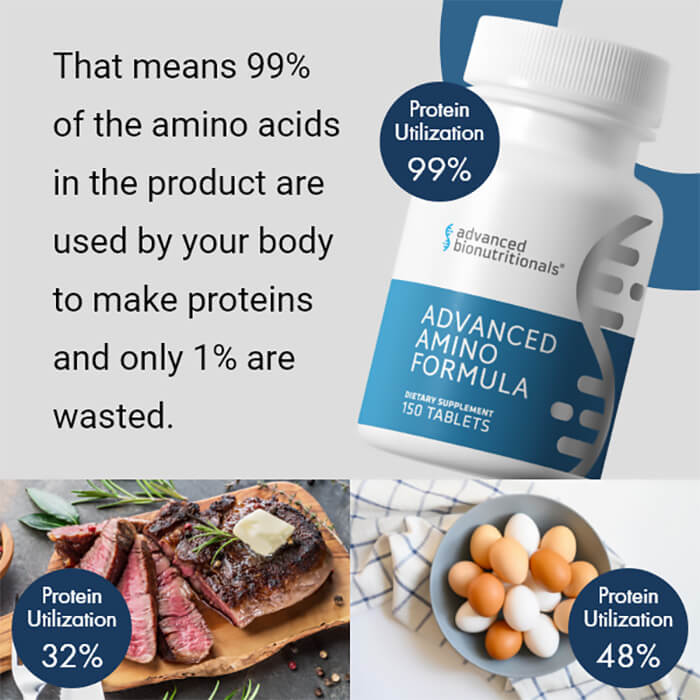
Advanced Amino Formula is a tablet product with a free-form blend of eight essential amino acids (~5,000 mg blend per serving often five tablets; no histidine; proprietary blend). Follow the live label.
Fit: you already fix breakfast/lunch with food, but one meal regularly stays too small and you want a compact EAA top-up.
Skip if: you expect tablets to replace meals/training, need all nine EAAs with per-amino milligrams, or have PKU/kidney-liver limits without clinician clearance.
If that matches, review the current offer: Advanced Amino Formula.
Quick daily checklist
- Protein at breakfast — yes or no?
- Roughly ~25–40 g at two to three meals?
- Avoiding tiny morning / giant night?
- Strength sessions this week?
- Only then: EAA top-up for the weakest meal if needed
FAQ
How much protein per meal after 50?
Many guides cluster around ~25–40 g per meal, or ~0.4 g/kg per meal across the day. Guides, not prescriptions.
How much protein at breakfast after 50?
Closer to a full per-meal target than a token snack — adjusted to what you can digest and repeat.
Can EAA tablets replace a protein meal?
No. They may top up essentials when a meal is small.
Does meal spacing matter after 50?
For many older adults, yes — long gaps and one giant dinner underperform.
Bottom line
Protein per meal after 50 is the overlooked half of the protein conversation. Fix breakfast. Spread doses. Train. Sleep. Use tablets only as a top-up for weak meals — not as dinner in disguise.
If you want a compact eight-amino option for undersized meals, inspect Advanced Amino Formula after the plate plan is real.


