
Somewhere after the menopausal transition, many women notice a quiet shift that is easy to blame on “just getting older.” Clothes fit differently. Stairs ask for the handrail more often. A suitcase that used to feel ordinary now feels oddly heavy. That pattern is often muscle loss after menopause — not a vanity problem, but a change in the physical reserve that supports independence.

This Miracoulia Health guide explains why the shift shows up, why walking alone rarely fixes it, how protein and essential amino acids for women over 50 fit the picture, and when EAA tablets for women over 50 can be a practical bridge — after training and food, not instead of them.
Educational note: This article is for information only. It is not medical advice, diagnosis, or treatment, and it is not guidance about hormone therapy. Talk with your clinician before starting any amino-acid supplement, especially if you have kidney or liver disease, are on a protein-restricted diet, take prescription medications, or have phenylketonuria (PKU). Individual results vary.
Why muscle loss after menopause feels different
Menopause is not only about hot flashes. Declining estrogen, shifts in body composition, and years of reduced progressive strength work can stack together. Women and men both experience age-related muscle change, but the postmenopausal years often make the drop in lean tissue and strength feel sharper — especially if training and protein were already inconsistent.
Clinical language sometimes uses sarcopenia for more advanced loss of muscle strength, quantity or quality, and performance. You do not need that label to take early functional signs seriously. Independence is the real target: rising from a chair, carrying groceries, traveling, and recovering after ordinary activity.
For the broader midlife picture (not menopause-specific), see our guide to muscle loss after 50: signs, causes, and what helps.
Common early friction points after menopause:
- Chair stands and low sofas feel “stickier”
- Stairs need more handrail support
- Bags, luggage, or laundry baskets feel heavier
- Recovery after a long walk or light workout takes longer
- Appetite or meal size drifts down while protein needs stay high
None of these alone proves a diagnosis. Together, they are a reason to protect muscle on purpose.
Walking helps — it is not enough
Walking is excellent. Keep walking. Cardio supports heart health, mood, and daily movement. What it usually does not do well enough on its own is give every major muscle group a progressive overload signal.
Strength training after menopause — machines, dumbbells, bands, or careful bodyweight progressions — remains the foundation for preserving muscle after menopause. Two to three full-body sessions per week is a realistic starting point for many beginners. The goal is adaptation, not exhaustion: sit-to-stand or squat patterns, a hip hinge, a push, a pull, and a simple carry or trunk exercise.
If your goal is to build muscle after 50 in a practical sense — stronger stairs, better carrying, more confidence — resistance work is non-negotiable. Supplements cannot recreate that mechanical signal.
Protein after menopause: building blocks, not a slogan
Resistance training creates demand. Protein supplies amino acids — the building blocks muscle uses for repair. With age, muscle often becomes less efficient at responding to the same meal that once felt “enough” (anabolic resistance). That is one reason expert nutrition groups frequently discuss higher protein attention for older adults than the minimal RDA framing — especially when illness, calorie restriction, or low appetite are in play.
Practical translation for women over 50 (not a personal prescription):
- Include a meaningful protein source at breakfast, not only at dinner.
- Spread protein across the day rather than saving it all for one large evening plate.
- Prefer foods you will actually finish: eggs, fish, poultry, Greek yogurt, cottage cheese, soy foods, legumes, or mixed meals.
- If you are actively losing weight, protect training and protein even more carefully — scale weight down is not the same as a healthier body composition.
Leucine often gets headlines because it helps switch on muscle protein synthesis. Muscle still needs a wider set of essential amino acids, not leucine alone. That is why broader EAA-style support usually has a clearer nutritional rationale than BCAA-only products when someone is shopping for amino support. For the full comparison, read EAA vs BCAA after 50.
Where essential amino acids for women over 50 fit
Essential amino acids for women over 50 are not a replacement for meals, and they are not hormone therapy. They are optional support when you already (or are starting to) train and eat protein — and you still hit a practical gap.
Situations where a compact EAA format often comes up:
- You dislike or cannot finish protein shakes
- Some meals stay small even when you plan well
- You want amino support near training without another dairy drink
- Convenience is the difference between consistency and quitting
Research themes in older adults — including work involving amino acids alongside resistance training — sometimes show improvements in strength or physical-function measures more readily than large gains in muscle mass, and certainty of evidence is often limited. In plain language: amino acids may help some women when paired with training and nutrition, but they are not a proven shortcut to rebuilding a physique, and results vary.
For the home-routine foundation (not menopause-only), see essential amino acids after 50. Browse more of Miracoulia Health’s muscle-after-50 articles for related reading.
Hierarchy that keeps you honest
Use this order every time marketing gets loud:
- Resistance training (progressive, joint-friendly)
- Food protein and enough calories
- Sleep and recovery
- Daily movement (including walking)
- Supplements to fill a real gap
If step 1–3 are missing, buying tablets first is usually the wrong problem to solve.
EAA tablets for women over 50: when the format wins
EAA tablets for women over 50 win on logistics more often than on magic biochemistry. No shaker. No rinse. No chalky sweet drink when appetite is already picky. That matters if shakes feel heavy, dairy is uncomfortable, or you simply will not mix a powder three times a week.
Tablets do not automatically beat whey. Whey (or food) still wins when total daily protein is clearly too low. Tablets become interesting when protein is roughly on track — or when a small meal needs a compact amino top-up — and format is the bottleneck.
Advanced Amino Formula: honest product facts
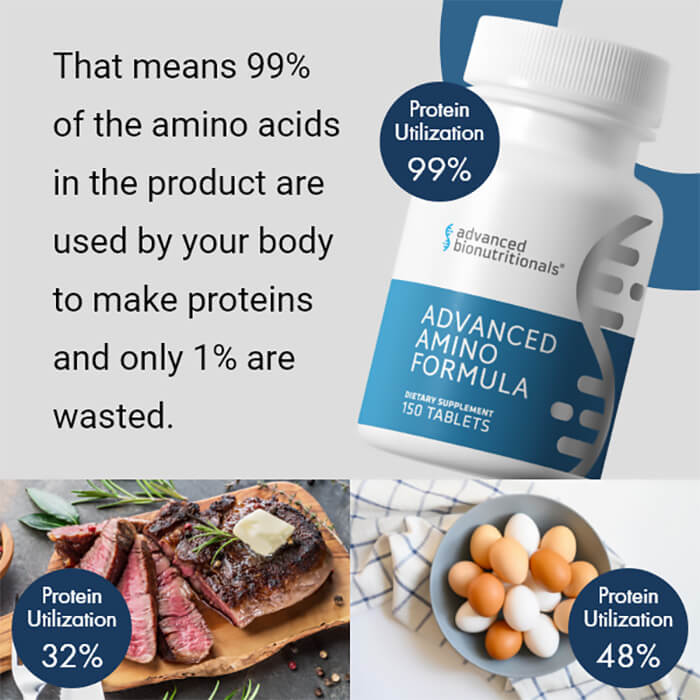
Advanced Amino Formula (Advanced Bionutritionals) is a tablet-based free-form essential amino acid product. Company materials emphasize muscle-support use cases for adults concerned about age-related muscle decline. Treat those as manufacturer claims, not personal guarantees.
What the current formula typically offers (always verify the live Supplement Facts):
- A free-form amino-acid blend — about 5,000 mg per serving on common labeling, often five tablets, with roughly 150 tablets per bottle (~30 servings)
- Eight listed essential amino acids: L-Leucine, L-Valine, L-Isoleucine, L-Lysine HCl, L-Phenylalanine, L-Threonine, L-Methionine, and L-Tryptophan
- No histidine — so this is not a full “all nine EAAs” product by modern textbook counting
- Label focus on the total blend, not always a full milligram breakdown of each amino acid
If you specifically want histidine included, or full per-amino milligram disclosure, compare labels before you buy. If your priority is a compact format you will actually take beside training and food, an eight-amino tablet blend can still be a rational fit — once you accept what is and is not on the bottle.
Light real-world note (secondary only): Some customers describe better everyday energy. One shared line is Jacqui’s comment that it felt like her muscles were “waking up and working.” That is a supporting testimonial, not a menopause-specific clinical proof point and not the spine of this article. Your results may differ.
When you want to inspect the live label, serving guidance, and current terms, open the official Advanced Amino Formula offer.
Buy-if / skip-if (postmenopausal readers)
Consider EAA tablets if you:
- Are already prioritizing (or starting) strength training after menopause
- Eat protein on purpose but still hit messy meal days
- Prefer tablets over shakes
- Accept an eight-EAA (no histidine) label after reading Supplement Facts
- Want a dairy-free-style amino option (confirm current manufacturer claims on the live page)
Skip for now if you:
- Expect tablets to replace walking, lifting, or hormone decisions with your clinician
- Barely eat protein and refuse to fix food first
- Need all nine EAAs including histidine on the label
- Have PKU, significant kidney/liver disease, or clinician-directed protein limits without clearance
- Only need a generic “muscle loss after 50” explainer (see the signs/causes guide) or a travel/appetite-specific post
A simple 30-day framing (no miracle timeline)
Week 1: Lock two strength sessions. Add a real protein source at breakfast.
Weeks 2–3: Keep the same movements; add small load or reps when ready. Sleep like it matters.
Week 4: Judge function — chair stands, stairs, carrying, recovery — not only the mirror.
If tablets are part of that plan, follow the current label serving and give training + food enough time to matter. You can review bottle options and guarantee terms on the official product page.
Safety reminders
- Phenylalanine is in the formula — people with PKU need clinician guidance.
- Kidney disease, liver disease, pregnancy, breastfeeding, and complex medication lists deserve professional review.
- More tablets are not automatically better.
- This is educational content, not a treatment plan for sarcopenia, osteoporosis, or menopausal symptoms.
FAQ
Why do women lose muscle after menopause?
Hormonal change, body-composition shifts, lower progressive resistance training, and inconsistent protein often stack together. Muscle loss after menopause is common as a pattern — not inevitable as a destiny. Training and nutrition still change the trajectory.
Is walking enough to stop muscle loss after menopause?
Walking is valuable and usually not sufficient alone. Progressive strength training after menopause provides the overload signal walking rarely matches for all major muscle groups.
Do essential amino acids help postmenopausal women?
They can supply building blocks and may support some strength or function outcomes when paired with resistance training and adequate nutrition. Evidence is not a guarantee of large muscle-mass gains. Essential amino acids for women over 50 work best as support, not as the whole plan.
Are EAA tablets better than a protein shake for women over 50?
Different jobs. Shakes (or food) help raise total protein. EAA tablets for women over 50 offer a compact format when shakes feel heavy or inconvenient. Fix chronically low protein first.
Can amino acid tablets replace HRT for muscle?
No. Hormone therapy decisions belong with your clinician. Amino-acid tablets do not replace medical care for menopausal symptoms or bone health.
Does Advanced Amino Formula include all nine essential amino acids?
No. The current formula lists eight and does not include histidine. That is a legitimate detail to weigh before buying.
Where can I see the current official offer?
Here: Advanced Amino Formula — official offer. Confirm pricing, guarantee terms, tablets per serving, and the live Supplement Facts before you order — commercial pages can change.
Bottom line
Muscle loss after menopause is often a functional story: stairs, chairs, bags, recovery, independence. Walking helps. Strength training and deliberate protein do more of the heavy lifting. Essential amino acids for women over 50 can fill a practical gap when format or meal size gets in the way — and EAA tablets for women over 50 are easiest to defend when training and food already come first.
Advanced Amino Formula is worth evaluating if you like tablets, accept an honest eight-amino label (no histidine), and will not use a bottle as a substitute for the gym or the plate. If that tradeoff fits, inspect the current formula and terms here: Advanced Amino Formula.


