 Miracoulia Health Editorial Team
September 17, 2026
amino acids
,
Build Muscle
,
health news
,
Muscle Loss
Miracoulia Health Editorial Team
September 17, 2026
amino acids
,
Build Muscle
,
health news
,
Muscle Loss
Muscle mass loss after 50 is not only “eat more protein.” Anabolic resistance, leucine, training, and where essential amino acid tablets fit—honestly.

Somewhere after 40—and more clearly after 50—many people notice the same quiet change.
Stairs ask for the handrail more often. Getting out of a low chair takes a second push. Suitcases and grocery bags feel heavier than the label suggests. The week did not suddenly become harder. The body simply answers more slowly.
That pattern is the everyday face of muscle mass loss after 50. It is easy to blame “just aging,” then buy more protein powder and hope the mirror catches up. Protein still matters. It is also not always enough on its own—especially when training is inconsistent and older muscle becomes less responsive to the same meal that used to work.
This guide explains why, what anabolic resistance means in plain language, where leucine for muscle protein synthesis and a fuller essential amino acid (EAA) set fit, and when a tablet formula like Advanced Amino Formula is worth considering—after the basics, not before them.
Educational note: This article is for information only. It is not medical advice, diagnosis, or treatment of sarcopenia or any disease. Unexplained weakness, rapid weight loss, or sudden functional decline deserve a clinician’s attention. Individual results vary.
Early functional signs (before the label)
Muscle strength after 50 often fades in function first, aesthetics second:
- Chair stands and sofa exits feel stickier
- Stairs and hills leave deeper fatigue
- Carrying loads feels oddly hard
- Recovery after ordinary activity stretches longer
- Training still happens, but progress stalls
Clinical language may eventually use sarcopenia for more advanced loss of mass, strength, and function. You do not need that word to take early signs seriously. Independence is the real target.
For a fuller signs-and-causes walkthrough, see our guide to muscle loss after 50.
Anabolic resistance: why “just eat more protein” can stall
Anabolic resistance is a useful phrase for a simple idea: with age, muscle often responds less strongly to the same protein stimulus.
In practice that can look like:
- A protein-rich meal that used to “land” now feels less effective
- Long gaps between protein-containing meals
- Relying on one big dinner while breakfast stays light
- Expecting powder alone to replace progressive loading
Leucine is one key signal amino acid for turning on muscle protein synthesis, but signal without materials—and without training—is incomplete. That is why conversations about essential amino acids after 50 usually sit beside resistance training and total daily protein, not instead of them.
Sales pages sometimes cite dramatic lifetime muscle-loss percentages. Treat those as common marketing context, not your personal forecast. Your trajectory still depends on loading, protein distribution, sleep, and health.
Leucine + a fuller EAA set (without turning this into a textbook)
How to prevent muscle loss after 40 starts with habits, then chemistry:
- Progressive resistance training (the non-negotiable signal)
- Enough protein and calories from food, spread across the day
- Sleep and recovery
- Optional concentrated amino-acid support when a practical gap remains
Leucine helps “switch on” synthesis. The other essential amino acids help supply building blocks. BCAA products give you three amino acids (leucine, isoleucine, valine). An EAA-style blend aims wider. For the side-by-side, see EAA vs BCAA after 50. For the broader EAA education piece, see essential amino acids after 50.
Training + protein hierarchy (keep this order)
A sane stack for muscle mass loss after 50:
| Priority | Action | Why |
|---|---|---|
| 1 | Resistance work 2–3× / week | Mechanical signal muscle understands |
| 2 | Protein-containing meals | Building blocks + calories |
| 3 | Sleep / recovery | Adaptation happens off the floor |
| 4 | Optional EAA tablets | Fill a practical gap |
Flip the order and you get expensive bottles with the same weak chair stand. If your goal is getting stronger in practice, also see build muscle after 50.
Tablets vs shakes (brief—not a remake of article #1)
EAA vs protein shake over 50 is usually a format and total-protein question:
- Shakes / whey shine when you need more total protein and calories
- EAA tablets shine when you want a compact essential-amino dose without another large serving
- Neither replaces training
This article’s main point is not “tablets beat shakes.” It is: protein strategy has to respect anabolic resistance and loading—then you choose a format you will actually use.
When Advanced Amino Formula may fit
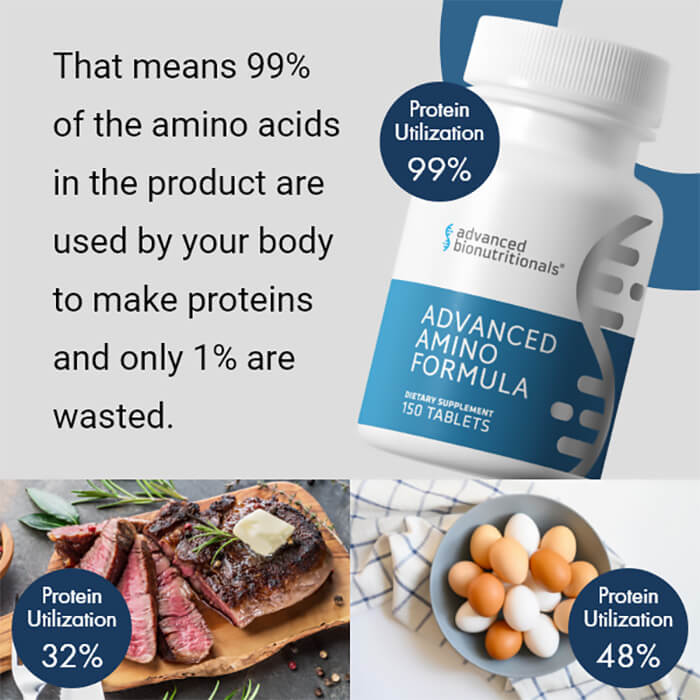
Advanced Amino Formula is a tablet product with a free-form blend of eight essential amino acids (leucine, valine, isoleucine, lysine, phenylalanine, threonine, methionine, tryptophan). Materials commonly describe about a 5,000 mg blend per serving (often five tablets). Follow the live label.
It may fit if you already train (or are starting), eat decent protein, and want a compact EAA option as support—not as your whole plan.
Honest limits:
- Eight EAAs listed; histidine is not included (many references list nine)
- Total blend is clearer than per-amino milligrams
- Manufacturer muscle claims are company claims, not your guarantee
- PKU, significant kidney/liver disease, or complex medications need clinician guidance on concentrated amino acids
One user, Jacqui, described better energy and muscles that felt like they were “waking up and working.” Treat that as a personal testimonial—secondary color—not proof that anabolic resistance disappears for everyone.
If the fit matches your routine, review the current formula and offer here: Advanced Amino Formula.
Safety notes (short)
This content is educational. Concentrated amino acids are not appropriate for everyone. People with phenylketonuria (PKU) must only use phenylalanine-containing products under medical supervision. When in doubt, ask a qualified clinician before you start.
FAQ
Is muscle mass loss after 50 inevitable?
Decline is common; the rate is modifiable with training, protein distribution, and recovery. Supplements are optional support.
What is anabolic resistance in plain English?
Older muscle often needs a clearer training signal and well-timed amino acids to respond the way it used to.
Do I still need protein food if I take EAA tablets?
Yes. Food first. Tablets do not replace meals.
Is sarcopenia the same as normal aging weakness?
Sarcopenia is a clinical spectrum. Early functional friction still deserves attention even without a label.
Where do essential amino acids after 50 fit?
After progressive loading and adequate food protein—as a practical way to support essentials when that helps consistency.
Bottom line
Muscle mass loss after 50 is rarely solved by “more powder, same lifestyle.” Anabolic resistance helps explain why protein alone can disappoint when training and distribution are weak.
Keep the hierarchy: train, eat, sleep—then decide whether an EAA tablet belongs as support. If that is your situation, you can inspect Advanced Amino Formula with clear eyes: eight listed essential amino acids, real limitations, and no promise that a bottle outruns the work.
Start with the chair stand and the protein at breakfast. Build from there.


