
Your calendar is full. Emails, meetings, driving, screens. You are not “lazy.” You are busy.
You are also sitting — often six, eight, or nine-plus hours a day. After midlife, that pattern collides with a quieter problem: sitting all day muscle loss after 50 can sneak in while your to-do list still looks impressive.

This Miracoulia Health guide explains what prolonged desk time is (and is not) associated with for muscle, why standing breaks help but rarely replace progressive strength work, how protein still matters on long office days, and where free-form essential amino acid tablets can fit as compact support when meals get skipped or tiny — without pretending a bottle replaces lifting or moving.
Educational note: This article is educational, not medical advice. Associations in research are not the same as “sitting alone causes disease X.” Talk with a qualified clinician before concentrated amino-acid supplements if you have PKU, kidney or liver disease, a protein-restricted diet, or complex medications. If you have fall risk, uncontrolled pain, or recent surgery, get clearance before adding resistance work.
Busy desk life is not protected muscle
Desk job muscle loss midlife often hides behind productivity. Cognitive load is not a muscle-maintenance stimulus. See early signs of muscle loss after 50 and how to maintain muscle after 50. Distinct from restarting after illness — here the reader is still working; the chair is the pattern.
What research-minded practice says
More sitting time is often associated with poorer muscle outcomes — treat as a risk pattern, not a single-cause verdict. Breaks help; muscle still needs resistance work plus protein, sleep, and recovery.
Break up sitting — helpful, not enough alone
Standing desks and walking meetings help interrupt sits. They rarely replace progressive resistance. Standing breaks vs resistance training after 50 is both/and. Stand or walk a few minutes each hour when possible — and still lift 2–3× per week. Build context: what actually builds muscle after 50.
Progressive resistance 2–3× / week
~20–40 minutes: squat/sit-to-stand, hinge, push, pull, carry/brace. Schedule before inbox or protect lunch. Bands/home floors count.
Protein across long desk days
Coffee-only mornings and working through lunch shrink amino-acid intake. Aim for protein you will finish across the day (~1.0–1.2+ g/kg coaching guides when training; clinician limits first). Spread across two to three occasions.
Where EAA tablets fit
Compact top-up when lunch vanishes — not a replacement for breaks or lifting. Foundation: essential amino acids after 50.
Advanced Amino — honest label
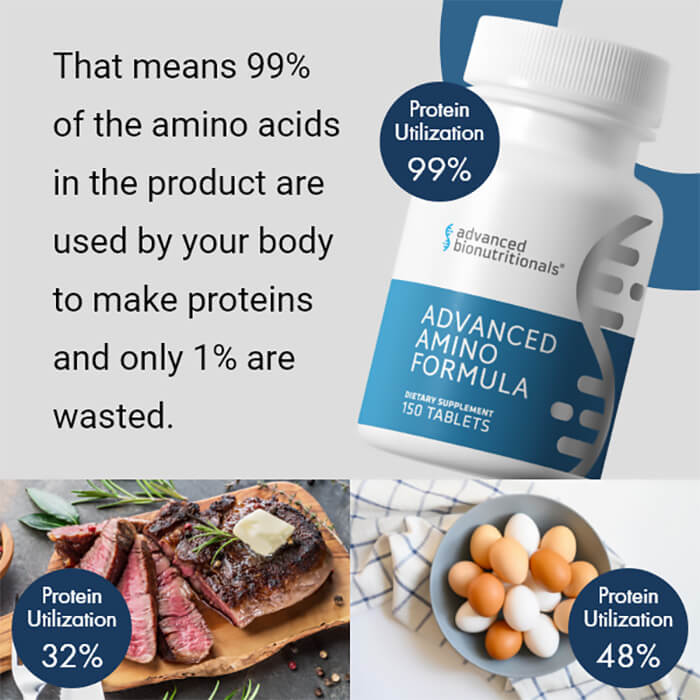
Advanced Amino Formula — eight EAAs (no histidine); ~5,000 mg blend / often five tablets. Follow the live label.
Buy-if: long desk days, you still lift, food protein mostly protected, want compact EAA when meals shrink.
Skip-if: tablets as standing/lifting substitute; PKU/kidney-liver without clearance; need nine EAAs disclosed individually.
Review: Advanced Amino Formula.
Hierarchy (desk edition)
- Resistance 2–3×/week · 2. Food protein · 3. Sleep · 4. Optional EAA on compressed weeks
FAQ
Does sitting all day cause muscle loss after 50? Associated risk pattern — strength and protein still decide much of the outcome.
Are standing desks enough? Help breaks; rarely replace progressive resistance.
Can EAA tablets help? When meals are skipped or tiny, if training and food remain the foundation.
Bottom line
Sitting all day muscle loss after 50 is usually what happens when a busy chair week steals progressive load and protein — not when you “failed” by having a desk job.
Keep the career. Defend the muscle. Inspect Advanced Amino Formula after the training and food plan is real.
Break the sit. Load the muscle. Feed the day. Bottle last


